Infolinks In Text Ads

Showing posts with label UK. Show all posts

Tuesday, 25 January 2011

Bulwark back at sea

3rd Street Promenade


NOW this is a sight to warm the cockles of British hearts in a cold, dark winter.
Dark being particularly pertinent here, for it was in the fading light of a late January afternoon that HMS Bulwark put to sea for the first time in nearly a year.
The assault ship has undergone an eight-month overhaul in the hands of Babcock in Devonport.
In those eight months, some £32m has been spent revamping the ship’s machinery spaces,  magazines, her high voltage propulsion system, advanced communication sensors, computer and IT network, and upgrades to her defensive weapons systems.
Another significant improvement has been Bulwark’s conversion to full tactical night vision for her landing craft and helicopters; the overhaul means that she will now be able to operate two Chinooks simultaneously from her flight deck.

That’s a little while off; first several weeks of equipment and engine trials beckon in the South Coast exercise areas, as well as bringing the 300-plus-strong ship’s company up to speed after so long alongside in Devonport.
Those initial trials should be done by the end of February, after which there’s the more demanding task of turning Bulwark back into a thoroughly-honed assault ship; come the autumn she’ll take over from her older sister Albion as the nation’s amphibious flagship.
"Sailing is an immensely-important and exciting moment for HMS Bulwark, for myself as her Commanding Officer, and for her ship’s company,” said CO Capt Alex Burton.
“It marks a significant milestone achievement for all who have worked extremely hard to make today possible.”
Picture: LA(Phot) Martin Carney, FRPU West

Wednesday, 19 January 2011

Work continues on the UK Queen Elizabeth-class aircraft carrier

Workers at BAE Systems in Portsmouth have begun work on the second major hull section of HMS Queen Elizabeth, the United Kingdom's new aircraft carrier. A steel cutting ceremony at the company’s facility this week marked the official start of production on the stern section, referred to as Lower Block 05. 

Weighing over 1000 tonnes on completion, this section will house switchboards, air treatment units and the vessel’s steering gear, as well as some accommodation areas. “This latest achievement in the Queen Elizabeth-class aircraft carrier programme follows the start of production on the forward section of the hull, Lower Block 02, which began in February of last year,” the company says in a publicity statement. 

HMS Queen Elizabeth and HMS Prince of Wales will displace about 65 600 tonnes at full load and will almost certainly be seen in South African waters in due course. The ships will measure 284 metres in length and will be capable of carrying up to 40 aircraft, including the Lockheed Martin F35 Lightning II. According to current planning, in terms of recent defence budget cuts, the Queen Elizabeth will only enter service in 2020 and the Prince of Wales is expected to be kept in a state of "extended readiness" after completion. 

The two supercarriers, described as the “biggest and most powerful surface warships ever constructed in the UK” will replace three ageing and much-less-capable Invincible-class light aircraft carriers in terms of a decision announced in the nation's 1998 Strategic Defence Review. The wikipedia notes that from six contractors, the UK Ministry of Defence (MoD) selected Thales and BAE Systems in late 1999 to compete for the final contract. In September 2002 the MoD announced that the Royal Navy and RAF would operate the short-take-off and vertical landing (STOVL) “B” variant of the F-35. The carriers would take the form of large, conventional carriers initially configured for STOVL operations. In January 2003 the MoD announced that the Thales design had won the competition but that BAE Systems would operate as prime contractor. The two companies are now part of a "carrier alliance" with the MoD and other companies.

The contract for the vessels was announced in July 2007, ending what was by then several years of delay over cost issues and British naval shipbuilding restructuring. Last year's Strategic Defence and Security Review has recast the Queen Elizabeth as a standard CATOBAR (catapult take-off and arrested landing) in order to operate the conventional carrier “C” variant of the F-35 instead of the STOVL variant in light of cost overruns and development difficulties with the latter. 

Steven Carroll, Queen Elizabeth-class project director at BAE Systems’ Surface Ships division, added the cutting of steel on the second section of the hull here in Portsmouth in less than 12 months highlights the tremendous progress we are making on the programme to deliver the nation’s flagships. The sheer scale of the hull as it takes shape in six shipyards across the country is a reminder that this is truly a once in a generation engineering project and we are all extremely proud to be a part of it.”

The Hampshire area is hub of activity on the Queen Elizabeth Class programme. BAE Systems workers at the Naval Base will also build island structures for the two ships and the pole mast, whilst integration and testing of the ships’ complex mission system is underway at the Company’s Maritime Integration and Support Centre on Portsdown Hill. Yet another team of BAE Systems engineers is testing the advanced communications systems for the ships. Elsewhere in the region, Southampton-based Kempsafe Limited has contracts to supply galley and laundry equipment on the vessels, and Portsmouth-based Selex Communications is involved in the design of the Identification Friend or Foe system.

This picture is replicated across the UK, with work underway at six shipyards employing 8000 people and thousands more across the supply chain. 

The last Royal Navy warship named Queen Elizabeth was in service from 1915 to 1948 and was the name-ship of the Queen Elizabeth-class of Dreadnought battleships. The name was then reportedly allocated to the CVA-01-class aircraft carrier cancelled by in terms of the 1966 Defence White Paper. The last HMS Prince of Wales was a King George V-class battleship commissioned in May 1941 and sunk by Japanese bombers that December. In her brief career she had helped sink the German battleship Bismarck and carried Prime Minister Winston Churchill to a conference with US President Franklin Roosevelt.

Tods Bow Sonar Domes For Australian Air Warfare Destroyers

Tods Bow Sonar Domes For Australian Air Warfare Destroyers
Composite materials specialists Tods Defence have secured the order for three Bow Sonar Domes for the new fleet of Royal Australian Navy 'Air Warfare Destroyers' (Hobart Class) which are due to start coming into service from 2013/14.

The Class is a derivative of the Spanish F105 design and is being developed by the Air Warfare Alliance comprising the Defence Material Organisation, Australian Submarine Corporation (ASC) and Raytheon Australia. It will be built at a new facility adjacent to the ASC facilities in Adelaide.
The design and build Bow Sonar Dome contract for Tods Defence is part of a continuing partnership with the Australian naval industry, with each of the new units being produced in the UK to coincide with the ship build programme.
Bow Sonar Dome enclosures are specifically designed to house underwater warfare detection systems and sensors. Variants of Tods products are now installed numerous platforms worldwide including F100 and F310 frigates, on the RN Type 45 destroyers and US Navy DDG 1000 Zumwalt Class ships.
Steve Burton, Managing Director Tods Defence say: "Although our design concept has been in proven service with a number of navies for thirty years, with each new class of vessel we have to work closely with international systems providers in their development so that we can fine tune particular customer requirements to provide the optimum performance."

Monday, 17 January 2011

Pay your last respects to Ark Royal this weekend

THERE is a last chance to see Britain’s greatest modern warship – and her ship’s company – this weekend.
The sailors of HMS Ark Royal will march through the streets of Portsmouth on Saturday as the city bids farewell to the most high-profile victim of last autumn’s defence review.
As well as that parade the carrier will also be opening its gangway for the final time to members of the public allowing a last tour of the 20,000-ton veteran of the Adriatic and Gulf wars.
The ship made her final entry to Portsmouth on a bitterly cold December day – snow and ice meant that only a few hundred, rather than the anticipated few thousand, onlookers witnessed Ark sail into harbour trailing her decommissioning pennant.
Even before that last entry, however, civic leaders vowed to celebrate the carrier’s 25-year association with her home port, inviting the ship’s company to march through the centre of Portsmouth.
And so at 11.20am on Saturday around 250 men and women from Ark Royal will form up in Paradise Street (in front of the city centre Tesco supermarket) before following a Royal Marines Band down Commercial Road – Portsmouth’s principal shopping street – past the railway station and into Guildhall Square.

Once in the square, there’ll be a half-hour service of thanksgiving for the sacrifices Ark’s sailors have made since 1985.
Ark’s final CO Capt Jerry Kyd, Portsmouth’s Lord Mayor Cllr Paula Riches and city council leader Cllr Gerald Vernon-Jackson will address the ship’s company and public, Ark’s bish will close the service with prayers, and proceedings will conclude with the carrier’s White Ensign being presented to the council.
Afterwards sailors and their families will be invited into the Guildhall for a reception.
Meanwhile, a mile away on Victory Jetty, the gangways will open from mid-day until 4pm on Saturday and 10am-3pm on Sunday.
Entry to Ark will be free, but it will be on a first-come, first-served basis; several thousand people are expected on both days (and, sadly, the ship cannot accommodate wheelchair users or pushchairs).
“It’s a real pleasure to be able to mark the links that Ark Royal has maintained with the city of Portsmouth throughout the past 25 years with a parade through the city, reception, and the opportunity to open my ship to the public for the final time,” said Capt Kyd.
“Ark Royal has played a very important role throughout her history and we have always been lucky enough to draw great affection and support from the British public wherever we go.
“I am only too aware that this famous ship and her iconic name mean a great deal to many people, but although Ark Royal will be decommissioned, the new Queen Elizabeth Class aircraft carriers are vastly more capable and will provide the Royal Navy with an exciting future.”
Cllr Vernon-Jackson added: “It’s very important the city celebrates the close links the Navy, and Ark Royal in particular, has with Portsmouth, and that residents have a chance to say goodbye to this special ship in this way. It’ll be a very moving day for the whole city.”
The White Ensign is lowered at sunset on Ark Royal in Portsmouth Harbour. Picture: PO(Phot) Ray Jones, HMS Ark Royal

Link with wartime bomb disposal heroes broken


THE Navy has lost a key link with its greatest generation with the death of legendary wartime bomb disposal officer Noel Cashford.
Lt Cashford, who has died aged 88, rendered more than 200 unexploded bombs and other devices safe during WW2 and its immediate aftermath.
He always played down his bravery saying simply: “I had my moments”, but his selfless actions meant he was appointed an MBE at the war’s end.
Although he left the Service in 1947 he remained passionate about the wartime work of his comrades,  supporting efforts to erect monuments, attending memorial services, giving speeches and compiling four books on the exploits of WW2 bomb disposal men.
“Today’s generation should know about the heroes of yesteryear and those who do the same dangerous job today,” he declared at 70th anniversary commemorations of the first German magnetic mine being defused by his friend Lt Cdr John Ouvry.
Lt Cashford was believed to be the last surviving naval wartime bomb and mine disposal officer.
“Over the past ten years, I have come to rely on Noel as a living link with our wartime explosive ordnance disposal heritage and will dearly miss his friendship, knowledge and valuable advice,” said Lt Cdr Rob Hoole, vice chairman of the Minewarfare and Clearance Diving Officers Association.
Lt Cashford praises the work of wartime comrades aboard HMS Belfast in 2009. Picture: PO(Phot) Mez Merrill

Saturday, 15 January 2011

Britain wants to cooperate with India in Navy ship building


NEW DELHI (PTI): Britain Friday said it wanted to extend cooperation with India in the field of naval ship building.


"There is a considerable scope. There are common things like the way we build ships in the UK. The way we operate is common with the way India does. We do think that naval area is one where there are immense opportunities," British High Commissioner to India Richard Stagg told reporters here.

India and the UK have had a long Navy-to-Navy relationship as both the aircraft carriers which the Indian Navy has operated were earlier in service with the British Navy.

India, which has embarked on a major modernisation plan for its armed forces, has emerged as a favourite with various defence equipment-manufacturing countries with its plan of spending over USD 100 billion on defence in the next ten years.

Friday, 14 January 2011

Defending the carriers


With Britain's Queen Elizabeth class aircraft carriers not due to enter service for nearly a decade and talk of strong new threats to carriers emerging, Dr Lee Willett, Head of RUSI's Maritime Studies programme, examines their viability


The United Kingdom's two Queen Elizabeth class aircraft carriers survived the 2010 Strategic Defence and Security Review (SDSR) – but only just. Despite the demonstrable strategic value of two highly flexible flat-topped ships in meeting a range of UK tasks from the high end to the low end of the spectrum, the carriers' fate hung in the balance right until the very end of the review. Even today, their fate may still not be secure. Despite carriers' demonstrated utility in Kosovo, Sierra Leone, Iraq, Afghanistan, the Asian tsunami, Hurricane Katrina, the Lebanon, Haiti and the ash cloud, questions continue to be asked about their strategic value. 

These questions generally can be grouped under two broad assumptions. The first is that they are expensive, inflexible Cold War relics. Yet £5bn to build two ships which can show the strategic flexibility to adapt to a range of circumstances and conflicts over up to 50 years of life demonstrates extremely good value for money. For example, the US Navy carrier USS Enterprise (CVN-65) is 49 years old, has more deployments due, and has seen active service during the Cuban Missile Crisis, Vietnam and Afghanistan – each a different crisis requiring a different response.

The second assumption is that carriers are militarily vulnerable. This article will address this second question.

It may be quite hard to sink a 100,000 – or 65,000 – ton ship. It is for this reason that the Soviet Navy carried nuclear-capable anti-ship cruise missiles during the Cold War, to help break free from the grip of the carrier-based vice that the US Maritime Strategy would place around the Soviet Navy's access to open water. However, in reality the requirement should not so much be to sink a carrier but just to stop its aircraft from flying. With this in mind, even a kinetic energy projectile penetrating the flight deck might prove to be enough.

The discussion of carrier vulnerabilities has raised the profile of several major anti-ship cruise and ballistic missile programmes. These include the joint Indian-Russian Brahmos super- and hyper-sonic cruise missile, the Russian SS-N-27 Klub cruise missile, the Chinese C-802 cruise missile and – perhaps most notably – the Chinese Dong Feng-21D anti-ship ballistic missile. This is not a hypothetical threat either: Hezbollah used a C-802 to sink an Israeli warship in the Lebanon crisis in 2006. Reflecting Cold War era Soviet thinking, the Chinese People's Liberation Army (Navy) strategic logic seems to be to develop such weapons as an anti-carrier capability, to give them an option for releasing the operational pressure likely to be created by the presence of several US carriers in the event of any high intensity conflict. In both strategic terms, such developments are not new. What is new, though, is the technology – both in terms of the missiles themselves and the systems intended to defend against them.

However, there are still two basic – and fundamentally erroneous – assumptions in the argument that short-range missiles provide a direct, indefensible threat to aircraft carriers. The first is that an aircraft carrier is a static, lone platform which anchors just offshore. In reality, an aircraft carrier has the ability to sit well over the horizon in the vastness of the ocean. Simply, finding a ship in large areas of water is tricky. Indeed, while a lot of the counter-carrier arguments in the SDSR appeared to emanate from proponents of funding more capability on the ground in Afghanistan, retired Army officer Patrick Hennessey noted in his acclaimed book The Junior Officers' Reading Club, while visiting a deployed Royal Navy carrier, that he "marvelled at how tiny and insignificant the little grey box ... was against the expanse of the ocean". Using tanking support, which it can carry itself if needed (as shown by the way in which the US Navy uses modified versions of its own F/A-18 Hornets to provide an indigenous tanking capability) a carrier can project power at ranges sufficient to allow it to stand well offshore. It also can move over 500 miles per day. So a carrier would not be a stationary, close-in target. There is also the question of whether a potential opponent has sufficient intelligence, surveillance, target acquisition and reconnaissance (ISTAR) capability to be able to find, fix and strike a carrier with the requisite degree of surety and with enough redundancy to deal with jamming capabilities. In terms of conventional anti-ship missiles, the reduced firepower compared to a nuclear weapon means that the missiles would also require a much greater degree of accuracy to ensure they find their target.

Second is the fact that this argument ignores the offensive and defensive capability of the carrier's battle group – its own dedicated self-defence unit. The carrier sits offshore behind this potent screen of offensive and defensive firepower. In the case of the UK's carriers, in combat circumstances the ship would likely be accompanied some of the most advanced warships in the world: an Astute-class submarine, able to deal with both surface and underwater targets; and one or maybe two Type 45 Daring-class air defence destroyers, with an anti-air warfare defensive suite with the potential to be developed to deliver an anti-ballistic missile capability. The short range of most of the anti-ship weapons means that their launch platforms would need to be much closer to the carrier itself, thus increasing significantly their own exposure to the defensive capabilities of the battle group.

The reality is that a potential adversary will have to first find the carrier and then negotiate heavy layers of defence which will need to be peeled away. Thus, making a carrier vulnerable may not be as simple as sometimes is assumed.

Yet, despite these challenges, major powers are continuing to develop an anti-carrier capability. The Chinese DF-21D is the most prominent example. While its capability and in-service date remain open to question, its 900-mile range from its land bases mean that there is no need to deploy a ship within range, or inside the range, of the task group. 

However, elements of the task group – such as land attack cruise missiles (such as the Tomahawk missile carried by the Astute boats), Joint Strike Fighters launched from the carriers themselves or the revived US conventional long-range bomber programme - can still hold land-based launch sites at risk. In terms of ship-based systems, the issue of having to deal with the defensive firepower of the task group itself is perhaps demonstrated by developments in the Russian SS-N-27 Klub-M anti-ship cruise missile programme. The missile can be fired from shipping containers. While generating this extra versatility – in terms of being able to fit warships with the weapon more quickly and cheaply – is probably the principal reason for this development, an added bonus would be the ability to position the weapon more discreetly, perhaps on land at a choke point or perhaps more notably on a commercial ship which might have a greater chance of getting further inside a carrier's defensive shield.

Whether the capabilities of these new weapons will be proved in due course to be credible, there has been some debate as to whether their emergence would be a game changer in terms of rendering carriers obsolete. It seems more likely that such developments will impact more on the modus operandi of a strategic asset such as a carrier, but this is where such weapons may have greater benefit as a tactical deterrent, giving a potential sea denial capability – for example reducing the desire of the US Navy to commit carriers into the Taiwan Strait in the event of a clash over Taiwan.

Perhaps the most significant questions in terms of carrier vulnerability is not anti-ship missiles, but submarines. Notwithstanding, in China's case, its building of large numbers of nuclear-powered and conventional-powered attack submarines (SSNs and SSKs) and notwithstanding the Chinese Song-class SSK found shadowing the USS Kitty Hawk carrier and its battlegroup in 2006, the challenge here for Western navies relates more to its own reducing focus on Anti-Submarine Warfare (ASW) as a discipline. Seen superficially as once again a Cold War requirement, following the collapse of the Soviet Navy at the end of the Cold War and to ward off arguments that Western SSNs were Cold War relics, major Western navies began adding to the tasking list of SSNs, including roles such as land attack. A consequence of this was a decline in submarine-based ASW skills sets. With other nations and navies around the world seeing submarines – especially those purchased off the shelf and particularly from the West – as a way of jumping the queue in terms of naval power, the threat to aircraft carriers may come more from below the surface than above it. Submarines are of course a principal platform for anti-ship cruise missiles, raising the issue of the threat from missiles such as the Brahmos and the Klub from a platform far better equipped to sneak into range.

Whatever the conclusions of this debate, the fact that key nations are placing a high priority on a range of anti-carrier capabilities certainly does one thing: it highlights the enduring strategic utility and importance of the carriers themselves.

Tuesday, 11 January 2011

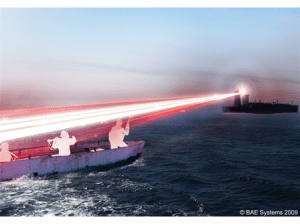
BAE Systems develops non-lethal laser to defend against pirate attacks on commercial shipping

Bristol, UK, — BAE Systems has successfully demonstrated a prototype device that will serve as an effective non-lethal deterrent against pirate attacks on commercial vessels such as oil tankers and container ships.
Piracy worldwide is on the rise according to reports from the ICC’s International Maritime Bureau (IMB), with 430 attacks worldwide reported last year, up from 406 in 2009. As pirates increase their range of operations and their capabilities, commercial shipping agents are increasingly looking for ways of preventing attacks whilst avoiding armed guards on their ships.
In order to help combat the growing piracy threat BAE Systems conducted a study of pirate’s behaviour and a company-wide capability survey. This led to the development of the concept of using a non-lethal laser, which would leave only temporary effects, to distract and deter potential attackers from a distance.
Laser Dome 500M Blowout Med 300x224 BAE Systems Develops Non Lethal Laser to Defend Against Pirate Attacks on Commercial Ships
Leveraging the capability of its Optics and Laser Technology Department within its Advanced Technology Centre, BAE System’s researchers conducted a number of experiments to assess the feasibility of laser distraction as a non-lethal weapon. The research team has now successfully demonstrated a suitable laser at the Pershore Trials Range in Worcester over a variety of distances in a variety of conditions.
The laser beam is capable of providing a visual warning to pirates at distances greater than 2km, and of disorientating attackers sufficiently at lesser distances so that weapons cannot be targeted effectively. At all times the power levels of the laser remain eye safe.
Roy Evans, BAE Systems capability technology lead for laser photonic systems, said: “The effect is similar to when a fighter pilot attacks from the direction of the sun. The glare from the laser is intense enough to make it impossible to aim weapons like AK47s or RPGs, but doesn’t have a permanent effect.”
The laser was trialled during night and day in varying weather conditions at the Worcester facility. Cameras were placed at the target location to demonstrate the level of beam intensity and divergence produced by the test runs. Beam oscillation techniques were also demonstrated.
The researchers have developed a bespoke Neodymium Yttrium Aluminium Garnet (Nd:YAG) laser which is an effective deterrent at relatively low power levels. By utilising targeting systems and changing beam patterns, the distraction effect can be made more pronounced and be used against multiple targets.


Evans continued: “We successfully showed that the laser works not just during the night, but also in full daylight. But, there are many more requirements to meet before placing a non-lethal laser weapon on commercial ships.”
When fitted on commercial ships the laser distraction system could utilise its own targeting capability or integrate with existing ship radar and sensor systems to control the direction and power of the beam. It could therefore work semi-autonomously and would also include security features to ensure it could not be used by pirates if they boarded the ship.
Bryan Hore, BAE Systems business development manager and the lead for the anti-piracy programme, said: “Laser distraction is part of a wider programme of anti-piracy technologies being developed by BAE Systems, including radar systems, which utilises expertise and knowledge from the military domain. The aim of the laser distraction project is now to develop a non-lethal deterrent to pirates, which has no lasting effects, which can work in a maritime environment, be operated by the crew at no risk, and be cost effective.” (BAE Systems)