Infolinks In Text Ads

Showing posts with label Pirates. Show all posts

Tuesday, 15 March 2011

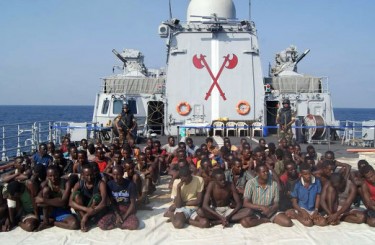
Indian Navy captures 61 pirates in Arabian Sea


The Indian Navy has seized a pirate ship, rescuing 13 crewmembers and arresting 61 suspected Somali pirates in the Arabian Sea, national media reported on Monday.
"The Vega 5, a pirate mother vessel, was intercepted by a fast attack craft, INS Kalpeni. Sixty-one pirates were apprehended and 13 crew members rescued," a Navy official said, adding that the incident happened on Saturday night.
The Navy said the INS Kalpeni directed "limited" fire on the vessel after being shot at.
The Indian Navy has deployed three ships in the Gulf of Aden and the Arabian Sea to deal with the piracy threat.
In January, India's Navy sank two pirate ships and apprehended 43 pirates.

Friday, 11 March 2011

U.S. charges pirates in killing of four hostages on yacht


Thirteen Somalis and one Yemeni have been brought to the United States to face charges in the seizure of a yacht with two American couples aboard who were later killed off the coast of Somalia, U.S. officials said on Thursday.

The accused pirates were charged with piracy, conspiracy to commit kidnapping and use of firearms during a crime involving last month's hostage-taking in which four Americans were kidnapped for ransom, according to court documents.

The defendants were not charged with murder, but a U.S. Justice Department official said more charges could be brought later.
The group seized the yacht and were negotiating with the U.S. military to release the couples when a pirate fired a rocket-propelled grenade at the guided-missile destroyer USS Sterett.

Gunfire then broke out inside the pirated vessel, prompting the U.S. military to send American special forces to board the vessel. The U.S. military has said the pirates shot the hostages before American troops boarded the yacht.

U.S. troops killed two pirates as they boarded the boat. Another two were found dead when special forces arrived but they were not killed by U.S. forces, the military has said.

The American victims were Jean and Scott Adam of California and Phyllis Macay and Bob Riggle from Seattle.

According to the indictment filed in federal court in Norfolk, Virginia, at least three defendants intentionally shot and killed the Americans without provocation before they could be rescued by the U.S. military.

The charges carry a maximum penalty of life in prison, U.S. officials said.

According to the indictment, the defendants conspired to unlawfully seize, kidnap, abduct and hold for ransom the four Americans on the yacht. They were armed with assault rifles and a rocket-propelled grenade when they boarded the yacht.

One defendant, Mohamud Salad Ali, went to the Sterett to negotiate on February 21, according to the indictment. The next day, a pirate fired a rocket-propelled grenade at the Sterett.

The case marked at least the third time that suspected pirates operating off Somalia have been brought to the United States to face criminal charges.
In February, a Somali pirate was sentenced in federal court in New York to 33 years and nine months in prison for his role in the 2009 seizure of the Maersk Alabama container ship.

In April last year, 11 defendants were brought to Norfolk to face charge for the attacks on two U.S. Navy ships off the coast of Africa.

Pirate gangs operating off the coast of Somalia have stepped up hijacking attacks on vessels in the Indian Ocean and the Gulf of Aden, making tens of millions of dollars in ransoms by seizing ships, including oil tankers, despite the presence of dozens of foreign naval vessels.

Wednesday, 2 March 2011

Maritime Bulletin: Somali pirates will pay 20% ransoms to radical islamists


Somali pirates came to terms with radical Islamic group Al-Shabab about partial payment of ransoms obtained by pirates for captured vessels, says editor of Maritime Bulletin Mikhail Voitenko referring to a source in Republic of South Africa. 

"The share is going to be 20%. In return, Al-Shabab is obliged to release several pirate leaders which had been arrested while capture of pirate's den Harardhere; also, pirates will be allowed to use Harardhere as a base, and so on", writes Voitenko in his posting on Gazeta.Ru. "The news is very bad, since it will be definitely used by numerous politicians and authorities who have been trying to forbid ransom payments for a long time", considers Voitenko. 
"Now they have a good reason, because Al-Shabab is classified by the U.S. as terrorist organization", explains Voitenko. According to his estimate, if ransoms become "impossible", shipowners would have to pay them "secretly", or pirates "would sell captured sailors to relatives". 

The editor of Maritime Bulletin also reminded that Somali pirates had released Japanese cargo ship Izumi for ransom. As for Voitenko, the 20-man crew consisted of Filipinos "is alive and relatively healthy". Amount of ransom was not reported. Being in pirates' captivity, the vessel was used as a mother-ship. Izumi was hijacked 170 miles southward Mogadishu on Oct 10, 2010.

Pirates captured Greek ship with Russian sailor on board


Pirates hijacked Panamanian-flagged Greek cargo ship MV Dover on Feb 28 in the northern part of the Arabian Sea, reports official website of EUNAVFOR Somalia. 

There is one Russian sailor in the crew, 19 Filipinos, and three Romanians. 

The ship was sailing from Pakistan to Yemen. Details of the capture are uncertain so far. There is no communication with the ship. Information about the crew's health status is not available either. 
However, according to online Maritime Bulletin – Sovfrakht, the crew has probably sheltered in one of the ship's compartments waiting for help. 

Late Jan 2011 cargo ship MV Beluga Nomination was captured 100 km off Seychelles; there were also Russian citizens aboard the ship. Reportedly, at least one of them was killed. 

Thus, according to Maritime Bulletin – Sovfrakht, Somali pirates currently hold three Russian hostages – one from MV Dover, one from MV Beluga Nomination, and another one from Tunisian tanker Hannibal II. 

In 2008 UN Security Council permitted foreign warships to operate in Somali territorial waters, although so far they have not managed to take control over piracy. Pirates' activity is explained by the fact that the state has virtually ceased to exist – there is no central authority in Somali, only separate non-recognized state formations.


Pirates hijack bulk carrier; capture Danish family

Pirates hijacked the Greek-owned bulk carrier MV Dover in the North Arabian sea yesterday, while the Danish government announced that pirates had captured a Danish family and their sailboat, including three children.

The MV Dover was seized by pirates about 260 nautical miles northeast of Salalah in Oman. "The Panamanian flagged, Greek owned vessel was on its way to Saleef (Yemen) from Port Quasim (Pakistan) when it was attacked," the European Union's anti-piracy taskforce said in a statement. The crew include three Romanian citizens, one Russian and 19 Filipinos.

Meanwhile, on Monday Denmark’s government said that pirates hijacked a Danish sailboat as it was crossing the Indian Ocean. The vessel sent out a distress signal on Thursday and is now being towed toward the Somali coast.

The yacht was carrying a Danish couple, their three children (ages 12 to 16) and two crewmembers from the Maldives to Suez. The Danish naval vessel Esbern Snare is heading towards the yacht’s position.

Danish Foreign Minister Lene Espersen said she was "deeply concerned," over the incident, according to the Associated Press. "It is almost unbearable to think that there are children involved, and I can only sharply denounce the pirates' actions.”

It is believed that this is the first time children have been kidnapped by pirates.

The incident was the second time in a week that a yacht was captured. On Friday 18 February Somali pirates hijacked the American yacht Quest while on its way to Djibouti.

The American naval vessel USS Sterett was sent to negotiate with the pirates on Monday but the next day gunfire broke out on the yacht. The four American hostages on board were killed along with two pirates. It is not clear who started firing first and it seems that the pirates may have begun fighting amongst themselves, the US Navy says.

The attack marked the first time American have been murdered by Somali pirates since a wave of attacks began six years ago. The United States said it may bring the 15 Somali pirates captured in the incident to American courts for prosecution over the killings.

In a separate incident, pirates released the Japanese vessel MV Izumi on Friday, the European Union naval force said yesterday. The Panama-flagged ship and its Filipino crew of 20 are believed to be making for a safe port. There is no information on the condition of the vessel or the crew. The ship was captured in October last year.

According to the International Maritime Bureau (IMB), there have been seven unsuccessful attempts at hijacking ships off the Somali coastal region during the last five days. The IMB reports that Somali pirates are currently holding 33 vessels and 711 hostages.

Friday, 25 February 2011

Piracy affecting Grindrod


JSE-listed shipping and logistics business Grindrod says piracy has affected the group’s earnings in the year to December. CE Alan Olivier says piracy off the Horn of Africa has had a negative impact on the South African firm's bottom line.

Business Report newspaper says today the miscreants have affected particularly in the group’s Capesize bulk carrier business that mostly carries contractual cargo from Brazil into the Persian Gulf region. Olivier said Grindrod had to divert its ships around the high-risk zone in the Indian Ocean as far as possible, which obviously added significant cost. “Effectively we are losing a voyage a year so when we would be doing six voyages a year (a ship) we are now doing five voyages a year and receiving the same revenue,” he told he business daily.
“But it does have a positive impact in that if you can only do five voyages a year you need one sixth more ships in the market, which absorbs more ships into the market.” The absorption of ships will reduce the oversupply and improve the potential to increase shipping rates. Olivier added that piracy was also having a negative impact on the chemical side of the group’s business because there was a significant chemical trade into the east Africa coast and the Persian Gulf region. 

He said there were increased insurance costs, higher fuel costs for deviations and the cost of exercising best management practice, which involved improving security by putting razor wire around ships and installing water cannon, Business Report continued. All of this added cost to the operation of ships, he said. While Grindrod did not have a significant number of ships trading specifically into that area, Olivier said pirates had been operating in Mozambican waters and 1500 nautical miles off the Somali coast “so they are right across the ocean”. 

Olivier said the group had not had any recent piracy incidents, but some of its partners had and one of Grindrod’s Capesize carriers was followed for about 40 minutes about 18 months ago before the pirates gave up. Grindrod yesterday reported that attributable income declined by 11% to R780.3 million in the year to December from R872.8 million in the previous year. The non-shipping business contributed 54% of Grindrod’s attributable income, which is the first time in the company’s 101-year history that shipping did not contribute the majority of the group’s earnings. 
Headline earnings a share declined by 12 percent to R1.676 from R1.896. 

Olivier attributed the decline in earnings and headline earnings a share primarily to a R166m impact from the stronger exchange rate of the rand against the US dollar, lower profits on the sale of ships of R21 million compared with R253 million in the previous year, and business development costs. 
But he said volume growth in ship operating activities, together with improved profitability from freight services and financial services, contributed positively to results. Revenue rose by 9% to R30.2 billion from R27.7 billion, while operating profit dropped by 16 percent to R963.7 million from R1.14 billion. A dividend of 54c was declared, 10 percent lower than last year’s 60c. 

Wednesday, 23 February 2011

WSJ: Pirate attacks leave round-the-world sailors with tough choices…


Days before the Quest set off on its doomed trek across the Indian Ocean, Bill Rouse, a Texan attempting to sail around the world, made Quest owner Scott Adam an offer.
Pirate attacks had become so intense, that he and a group of yacht owners decided to transport their vessels across the Indian Ocean by cargo ship. Rouse and the others would fly to Turkey to reclaim their yachts. The cost was steep, $35,000 a piece. There was space for the Quest.
Adam declined. The Quest was planning to sail as part of a convoy for safety. Plus, circumnavigating the globe under his own steam “was a life-long quest,” Rouse said Adam told him.
“He smiled,” Rouse recalled, “because of the obvious pun.”
Less than two weeks later, Adam, his wife, Jean and their two crew members Phyllis Macay and Bob Riggle, were dead at the hands of Somali pirates.
Pictured: S/Y Calypso, a 40-foot Bob Perry designed sloop owned by John and Margo Almeida circumnavigated via the Arabian Sea and Gulf of Aden between 1998 and 2008.
The dangers of piracy are well known to most experienced sailors, who monitor reports of attacks closely and often travel in groups through high-risk areas. But the killings have stunned the tiny, tight-knit international community of “blue water” sailors–adventurers and serious mariners who sail the globe for years at a time.
Now, many are changing course to avoid the Indian Ocean, others are scrambling to arrange transportation for their yachts on cargo ships. Some are demanding government action against the pirates, or escorts across dangerous waters.
“We cannot allow a bunch of thugs to take an entire ocean away from the world. Ignoring this will be disrespecting the deaths of the crew of Quest,” said Rouse, the Texan, from his yacht, Bebe, anchored off of Cochin, India.
(This story and related background material will be available on The Wall Street Journal website, WSJ.com.)
As piracy attacks have become more frequent, the U.S. and Europe have increased navy patrols.
But Somali pirates take orders from wealthy and powerful crime bosses who have thrived in the chaotic country. The Somali government is weak.
“The real problem here is that no one is tackling the problem at its root–on land,” said Pierre Prosper, a former Bush administration ambassador who has been advising the Somali transitional government on piracy and other security issues.
Some larger commercial ships and megayachts have taken to hiring armed escorts. That leaves individuals who can’t afford those precautions more vulnerable.
“We want government armed escort of private-vessel convoys through the danger area, as those of us now stranded in this part of the world (estimated at a few hundred boats) can’t afford the private armed guards that some commercial vessels are using, nor can we all afford to transport our boats on cargo ships,” Nancy and Burger Zapf wrote in an email from Phuket, where their vessel, Halekai is anchored.
Zapf said that she and her husband planned to sail across the Indian Ocean and the Red Sea to the Mediterranean as part of their plan to circumnavigate the world.
Changing course is difficult for some, who have spent years saving and planning to sail around the world. Many are now urging their fellow cruisers to take a different route, south around Africa’s Cape of Good Hope, notorious for turbulent seas and storms.
“We’re changing what our fears are. South Africa is not so scary, what’s scary are the pirates,” said Mark Jensen, an Australian who ran into Somali pirates trying to board a commercial ship last year during his trip around the world. Jensen said he “would never go back to that part of the world.”
Sevenstar Yacht Transport, an Amsterdam-based shipping company, is diverting resources to pick up last-minute requests from terrified yacht-owners. In the past few years, the company has shipped about 20 yachts a year. But in the first two months of this year, the company has already shipped 10 yachts, and plans to ship 15 more in the next few weeks.
On Wednesday, a day after news of the American deaths, the organizer of a convoy of 30 yachts in Thailand contacted Sevenstar to arrange transport across the Indian Ocean.
“People are so afraid,” said Richard Klabber, managing director of Sevenstar.
Leisure sailors point out that not everyone can afford that option. Many yacht owners, called “cruisers” or “yachties,” are retirees who have sold their belongings to fund their travel and live on a budget.
Klabber said his company is reducing its rates to accommodate the desperate. But the solution, he says, is simple: “They shouldn’t be there. They should just not be in that zone.”

Saturday, 19 February 2011

Russian tanker repelled pirate attack in Indian Ocean


Crew of Russian tanker NS Century belonging to JSC Novoship (member of company groupingSovkomflot) repelled attack of armed people in the Indian Ocean, reported RIA Novosti referring to the shipowner's press service. 


The incident happened on Feb 16 forty nautical miles off India. The tanker's crew noticed three boats heading towards the ship, and then the all-ship alarm was given. 


"When armed guards who were on board made a series of cautionary shots, the boats turned back and sailed away. Although it was not confirmed there were pirates in boats, the company's directors thanked the shipmaster and crew of NS Century for vigilance and expertise", reported the press service. 
Company grouping Sovkomflot is the world's fifth largest tanker company in terms of the fleet available. Russian government holds 100% shares of the company which comprises 132 vessels (126 of them are property of the steamship company). Overall deadweight is over 9.4 mln tons; active shipbuilding program implies 28 vessels with overall deadweight of 2.8 mln tons.


Thursday, 17 February 2011

Somali piracy becoming "criminal enterprise"


Somali piracy has evolved into a transnational, organised criminal network that risks becoming ingrained in the country's economic and social structures, says the head of the US counter-piracy unit.

Attacks on vessels off the coast of Somalia have been growing rapidly since 2007 as young Somalis in small skiffs with their AK-47s and rocket propelled grenades take to the waters to seek their fortunes.

Donna L. Hopkins, coordinator of Counter Piracy and Maritime Security for the US government, said it had become apparent that other nationalities were hoping to reap the benefits of what has become an increasingly lucrative activity, Reuters reports.
"Somali piracy has grown from being essentially a garden variety, local, off the coast protest against illegal fishing ... into a seriously networked and capable, transnational, organised and criminal enterprise," she said.

"We think there are other fishermen, fishermen other than Somali nationality, who are colluding in this business and helping to share the spoils."

Ransom payments have shot up over the last five years and now average around US$4.5 million to $5 million per ship, from around US$150,000 to US$300,000 previously, according to Dieter Berg, head of the marine division at reinsurer Munich Re.

By using bigger "mother ships" equipped with more sophisticated equipment, pirates have been able to carry out increasing numbers of attacks in recent months and range further away from the Somali coastline.

Last week Somali pirates seized two oil tankers in two days, capturing a Greek ship carrying Kuwaiti oil to the United States after taking an Italian oil vessel.

Hopkins said it was likely that sophisticated groups, potentially operating out of financial centres, had established networks to distribute fuel and weapons and transmit ransoms through money laundering networks.

"We need to find out who is complicit in the financial networks, other logistical supporting networks that are enabling pirates," she told reporters at the U.S. Embassy in London.

Regional instability along a critical trade route combined to make Somalia a "perfect storm" to fuel piracy, Hopkins said and warned it risked becoming an insurmountable problem.

"It's pretty clear from the reporting that's coming out that piracy is becoming deeply ingrained in the Somali economic and social structure," she said. "As long as there is no effective government to control the Somali territorial water and coastline this is going to be a problem."

Hopkins dismissed "deliberate links" between piracy and terrorism, but said militants would be attracted by the financial gains.

"Terrorists, no matter how ideologically pure, need money. And I suspect they are not above taking what they can." 

‘Hang the pirates’


Norwegian shipping magnate Jacob Stolt-Nielsen believes that stronger measures need to be taken to deal with Somali pirates, saying “The only way to put this business in decline is to hang them.”

He expresses his frustration at what he claims is the international community’s half-hearted approach to piracy, as pirates are often captured and released but seldom tried successfully in international courts. For instance, on Wednesday February 9 the Danish warship HDMS Esbern Snare released six Somali pirates who had been held since December 30, after being suspected of attacking the Danish ship Elly Maersk. They were release along the Somali coast due to a lack of evidence against them. It appears the pirates threw their weapons overboard when the crew of the Esbern Snare boarded their vessel.
In a separate incident on Saturday the 12th, the Esbern Snare stopped a suspicious vessel with two skiffs on its deck. A boarding party found equipment used for pirating ships, including boarding ladders, automatic weapons and rocket propelled grenades. 14 suspected pirates were arrested and two Yemeni hostages released, but the pirates were taken ashore and released as there was not enough evidence, despite all the equipment found, for a conviction in a Danish court.

“The only language these pirates understand is force,” Stolt-Nielsen told the Norwegian newspaper Dagens Næringsliv (DN). “Sinking their ship will all hands aboard is the way to solve the problem.”

Stolt-Nielsen of Stolt-Nielsen Limited says it stations armed guards on board its vessels, paying approximately US$1 million per month for its some 150 ships. Stolt-Nielsen CEO Niels G Stolt-Nielsen (Jacob’s father) told DN they have also used barbed wire and hot water to repel pirates.

Experts say 2011 will be one of the worst years for piracy - there have already been three successful hijackings in the past week. On February 8, Pirates attacked and boarded the Italian-flagged and owned oil tanker MV Savina Caylyn in the Indian Ocean, with 22 crew and US$60 million worth of crude oil on board. It is currently heading for the Somali coast.

On February 9 the MV Irene SL, a Greek-flagged and Panamanian owned tanker carrying 266 000 tons of crude oil worth US$200 million, was hijacked in the Arabian sea, and last Saturday the bulk carrier MV Sinin was hijacked by Somali pirates 350 nautical miles east of Oman in the northern Arabian Sea.

Presently there are approximately 700 crew and 30 ships being held by pirates, with many of these being used as bargaining tools and human shields – it is common for pirates to bring hostages out on deck and beat them if a warship comes too close. Indeed, pirates are becoming increasingly violent and willing to retaliate against international naval forces. On January 26 an element of the international anti-piracy contingent unsuccessfully tried to free the crew of the captured Beluga Nomination, and killed a pirate in the process. In retaliation the pirates shot and killed a Filipino crewmember.

Jacob Stolt-Nielsen believes eliminating the pirates is worth the risk of retaliation. “It is conceivable the pirates would take revenge on the crews they are already holding hostage, one must realise this. However, this is war, and wars cost lives,” he says.

“Pirates captured in international waters have always been punished with death, often carried out there and then. The Romans had problems in northern Africa, the Vikings were pirates, and North African so-called ‘Barbary Corsair’ pirates controlled the Strait of Gibraltar for hundreds of years,” Stolt-Nielsan said. “The business will only stop when it starts costing the pirates too high a price.”

Many pirates were hanged in the 17th and 18th centuries, most notoriously Captain William Kidd (1645-1701) and ‘Calico Jack’ Rackham (1682-1720). The last pirate to be hanged was Nat Gordon in New York in 1862. Most pirates were given summary trials and then "hanged from the nearest yardarm." As infamous captains, Kidd and Rackham received formal trials before execution. Their bodies were afterwards enclosed in iron cages and left to swing from gibbets until the flesh rotted off them.

Monday, 14 February 2011

Feature: pirates are ‘masters of the ocean’ – and what to do about it


As the world faces the prospect of the worst ever year for piracy, the United Nations has admitted that pirates are becoming masters of the ocean and that 90% of suspected pirates that are captured are released again.

Jack Lang, the United Nations Special Advisor on Somali Piracy and former French Culture minister said that “there is this race between the pirates and the international community, and progressively that race is being won by the pirates.”

“Piracy still increases,” Lang told the UN Security Council last month. “Nine out of ten pirates captured by naval forces are freed, despite efforts by many states to have a single jurisdiction,” Lang says, and adds that, "this impunity encourages piracy". Indeed, naval forces have released between 500 and 700 pirates over the last three years – some pirates have even been arrested several times, the Economist reports. 
In January this year there were 35 attacks on ships, with seven of them being successful, giving the pirates a further 148 hostages, according to the International Maritime Bureau (IMB). The situation will worsen in March when the monsoon abates and the Arabian Sea grows calmer - experts predict 2011 will be the worst year of Somali piracy. The IMB also reports that 1 016 sailors were taken hostage off Somalia last year and 49 ships hijacked, while 28 ships with 638 crewmembers are currently being held. 

According to Lang, “Piracy has created an economy with a level of sophistication. At first it was artisan, now it has taken on an industrial scope.” The rapid sophistication of its methods, organizational structures and resources have allowed pirates to demand high ransoms and launder money similar to the operation of a mafia. Ransom costs have increased markedly of late, amounting to US$238 million last year, or an average of US$5.4 million per ship, compared with US$150 000 in 2005 and $3.5 million at the end of 2009. The South Korean oil tanker Samho Dream set a new record when it was released for US$9.5 million in November last year.

“There are 1 500 [pirates] who are defying the world, defying the UN. We must act now, quickly and firmly,” Lang said. “So do we do nothing, or do we try to find more effective solutions?”

In a report delivered to the UN last month, Lang calls for a multi-dimensional approach to the issue: economic, security, and judicial or penitentiary. He stressed the need for effective specialised courts to prosecute captured pirates and equally the facilities to imprison them. He recommended the international community work towards “Somaliasation” of responses to piracy by setting up courts and prisons in Somaliland and Puntland in Somalia as well as in the Tanzanian town of Arusha. The Somali courts would operate under Somali jurisdiction and laws.

Lang called for a modest US$25 million special funding, in order to better coordinate and empower the fight against piracy. In comparison, the report estimates piracy costs the world economy $7 billion. The US$25 million would be used over three years.

In April last year, the UN Security Council called on all states to criminalise piracy under their domestic laws and urged Secretary-General Ban Ki-moon to consider setting up a regional or international maritime piracy tribunal.

Some 700 suspected and convicted pirates are now in detention in 12 countries, more than half of them in Somalia, according to Yury Fedotov, executive director of the UN Office on Drugs and Crime. 

At the moment very few countries are prepared to hold and prosecute pirates, while lawlessness in Somalia makes trials there practically impossible. Somalia has not had a central functioning government since the civil war that erupted following the overthrow of former president Mohamed Siad Barre in 1991. “The problem in Somalia is there is no state; this has been the case for twenty years,” Lang stressed, adding that political instability and poverty are rife, although the region of Somaliland is relatively stable and prosperous. 

Somalia’s neighbour Kenya has become the lead prosecutor of suspected pirates, after persuasion from the West. In 2009 The European Union, United States, United Kingdom, Canada, China and Denmark signed anti-piracy agreements with Kenya, the BBC reports. Eighteen Somalis are currently serving long prison sentences in Kenya, according to the Economist, and 130 suspected pirates captured since 2008 are currently being held by the country. 

In exchange for its help, the European Union invested roughly US$3 million in the country’s judicial system through the UN Office on Drugs and Crime, some of which went on building a special court for piracy trials. However, with its legal system already overloaded, the government is reluctant to take any more. In November last year a Kenyan High Court judge ruled in a case that the country had no jurisdiction over piracy committed in international waters, the BBC reports.

Meanwhile, the Seychelles has said it will host a second UN-supported centre to prosecute suspected pirates seized by foreign navies. It has amended its criminal code to enable it to prosecute them under universal jurisdiction, according to the BBC.

Despite the agreements with Kenya, suspected pirates have been taken to the Untied States, France, Yemen, Germany and the Netherlands, among others, for prosecution. In the first case to come to trial in Europe, a Dutch court sentenced five Somali men to five years in prison for attacking a Dutch Antilles-flagged cargo ship in the Gulf of Aden in 2009.

The International Maritime Bureau has said that the logistical and legal burdens involved in transporting pirate suspects to Western countries could be expensive and time-consuming. Another issue is if the pirates are set free, the prosecuting country has to deal with them and possibly grant them asylum - pirates captured by South Korea said they were liking their time in prison and had even asked to stay in the country, Reuters reports. The pirates were captured by South Korean commandos during a raid to free a hijacked chemical tanker on January 21. South Korean maritime police have formed a team of 50 officials to deal with the country’s first legal attempt to punish foreign pirates in a move that will be closely watched by other countries dealing with piracy.

The United Nations Convention on the Law of the Sea (UNCLOS) allows sovereign nations to seize and prosecute pirates but nations are often frustrated by cost, rules of engagement and politics. Whether a country wants to prosecute arrested pirates depends on its own law.

In their article, Fighting Piracy (which appeared in the February 2009 Armed Forces Journal), Commander James Kraska and Captain Brian Wilson state: "On the high seas or in any other place outside the jurisdiction of a state…pirated ships may be boarded, the pirates can be detained and the property on board the vessel can be seized and submitted to admiralty and criminal courts. The registry or 'flag' of the attacked vessel, the state of nationality of any of the victims or crew, the nationality of the on-scene warship, and, in some cases, coastal and port states, all have a valid basis for asserting jurisdiction. But it can take weeks or months to sort out these logistics and legal issues."

“If we do not act quickly, we will reach a point of no return,” Lang warned. “We can not spare our spending here.” Piracy costs between US$5 and US$9 billion a year, with a knock-on effect of increasing prices and reducing activity in the fishing and tourist industry, Lang said.

The UN and other organisations agree that solving piracy involves solving the issue on land, and not at sea, by creating economic prosperity, a functioning legal system and a stable government. 

So far no nation, not even the United States, has seriously contemplated fighting piracy on land by destroying pirate bases, according to the Economist. Instead, the international community runs several seaborne anti-piracy missions off North Africa, with the European Naval Forces Operation Atalanta, NATO-led Operation Ocean Shield and Combined Taskforce 151 led by Americans. Atalanta was originally set up to safeguard the United Nation’s World Food Programme aid deliveries to Somalia but has expanded to take on a general anti-piracy role. Other nations like South Korea, China, Japan, Iran, Russia, Saudi Arabia and India also have ships off the East African coast.

Although waters in the Gulf of Aden are now safer, the international efforts have pushed pirates move farther offshore, even going as far as India and Mozambique. Colonel Richard Spencer, the British chief of the EU’s naval force, told the Economist that policing this enlarged area would require five times as many warships as the international task forces can muster. According to Lang, “There are numerous gaps in the counterpiracy effort.”

While piracy off the Somali coast is most often in the spotlight, it is also a big problem in the Malacca Strait and the Caribbean, according to the International Maritime Bureau (IMB).

Pirates used to be most active in the Malacca Strait but piracy has been alleviated there through a successful campaign of patrolling, arresting, prosecuting and imprisoning pirates. Conditions onshore improved with a peace settlement among rebels in Aceh, which led to economic development and improved living conditions, Gulf News reports.

As the prospect of improving conditions in Somalia remains elusive, ship owners are exploring a variety of options to defend against piracy. BAE Systems, for example, recently demonstrated a prototype laser beam capable of “providing a visual warning to pirates at distances greater than 2 kilometres, and of disorientating attackers sufficiently at lesser distances so that weapons cannot be targeted effectively” at commercial vessels.

Italio-British company Selex Galileo has developed a detector, able to provide 2D and 3D imaging capability from a single laser illumination pulse (BiL) to give sailors enhanced recognition and identification capability, day and night.

In January Samsung Heavy Industries rolled out a system that alerts the crew to an approaching vessel and enables sailors to remotely fire water cannons at the attackers. Mace Personal Defence recently announced it had joined with Shipboard Defence Systems to create an anti-piracy device that would spray Mace pepper spray at boarders. Other anti-piracy systems work by using strobing lights to disorient attackers or firing a rope across the water to entangle propellers. 

Another device is the Long Range Acoustic Device (LRAD), which works at distances up to 300 metres by disorienting attackers with high energy sound. It was used in November 2005 when pirates attacked the Seabourn Spirit, and in November 2008 when the MV Biscaglia was attacked. The pirates failed to board the Seabourn Spirit but captured the Biscaglia.

Another solution is to have a protected ‘citadel’ or safe room from which crewmembers can safely steer the ship even with pirates aboard, until being rescued by naval forces. However, pirates are using explosives and cutting torches to breach some of these ‘citadels’.

Increasingly, ships are carrying private armed security guards - the German Ernst Komrowski shipping company said it will now have its 20 ships protected by armed guards and the Hamburg-based Offen shipping company says it will also put armed guards on ships passing through the pirate zone, Der Spiegel reports.

The problem with employing armed guards provokes a more brutal response from pirates while applying the historic cure for piracy – exemplary violence – would lead to many more dead hostages, the Economist reports. However, experts like US author Ralph Peters suggest that only when groups like pirates become exceedingly violent will the international community make a concerted effort to stamp out the problem. 

Meanwhile, ships sailing in risky waters have been given guidelines to maintain a high cruising speed (travelling at 18 knots or more makes it almost impossible for pirates to board), erect physical barriers and use hoses and foam to deter pirates.

Historically, piracy has been stopped by hunting down and destroying pirate ships and bases. Many pirates, such as William ‘Captain’ Kidd (1645-1701) and ‘Calico Jack’ (Jack Rackham – 1682-1720), were hanged in the 17th and 18th centuries. Indeed, there was a time when "to see to it that any man who sails under a pirate flag or wears a pirate brand gets what he deserves: a short drop and sudden stop" - a hanging - was not just Hollywood dialogue (in this case Lieutenant James Norrington in Pirates of the Caribbean). Captured pirates in previous eras were notoriously "hanged from the nearest yardarm." Indeed, the last pirate to be hanged was Nat Gordon in New York in 1862. 

Most studies of crime have concluded it is the certainty of capture and punishment (and not capture and punishment itself) that influences criminal behaviour. When nine out of ten pirates are released unpunished, it is hardly surprising that the IMB is predicting 2011 to be the worst year on record for incidents of piracy.

IMO spells out action needed to tackle piracy


Failure to implement fully the IMO guidance, including the industry-developed best management practices, significantly increases the risk of successful pirate attacks, the International Maritime Organization (IMO) said in a robust message to its Member States, following the launch on 3 February 2011 of IMO’s anti-piracy action plan, in support of the 2011 World Maritime Day theme: “Piracy: orchestrating the response”.

In a circular letter (No.3164, 14 February 2011), all IMO Members, the United Nations and specialized agencies, intergovernmental organizations and non-governmental organizations in consultative status are informed that naval forces operating in the region off the coast of Somalia have reported that an unacceptably high proportion of the ships transiting the Gulf of Aden and western Indian Ocean  are not registered with the Maritime Security Centre Horn of Africa; are not reporting to United Kingdom Maritime Trade Operations (UKMTO) Dubai; show no visible deterrent measures and are not acting upon the navigational warnings to shipping promulgating details of pirate attacks and suspect vessels.
In drawing attention to the increased risk of successful pirate attack due to failure to implement fully the best management practice guidance, IMO strongly urges “all those concerned, particularly Administrations, industry representative bodies, seafarer associations, shipowners and companies to take action to ensure that ships’ masters receive updated information unfailingly and that all the recommended preventive, evasive and defensive measures are fully and effectively implemented”. “Regrettably, there is disturbing evidence to show that, in too many cases, this advice has either not reached shipping companies or their ships or has not been acted upon,” the circular letter says.
The letter also encourages Member Governments (together with their endeavours at other fora and associations) to make greater efforts to provide the additional naval and aerial surveillance and other resources needed through every means possible.
The letter also invites Administrations to provide long range identification and tracking of ships (LRIT) information to security forces operating in the Gulf of Aden and the western Indian Ocean.  An information distribution facility (IDF) has been established to assist security forces operating in the Gulf of Aden and the Western Indian Ocean to build a more accurate picture of where the merchant ships are, in order to provide more timely warnings of pirate activity and to facilitate more effective repression of piracy and armed robbery against ships through the more effective deployment of the limited available naval and military resources.

Friday, 11 February 2011

Malaysia to charge Somali pirates under firearms act


Malaysia will charge seven Somali pirates with offences under the firearms act in a move that could see the men hanged if they are found guilty, said a statement from the Attorney General's office.

The pirates were captured in January by Malaysian commandos after they attempted to hijack a Malaysian-owned chemicals tanker, Reuters reports.

They were brought to Malaysia and were due to be charged in a court in the capital Kuala Lumpur later on Friday.

Somali piracy is a ‘threat to global oil supplies’


Ship hijackings could disrupt global oil supplies unless governments do more to combat piracy, the International Association of Independent Tanker Owners (Intertanko) says.

Intertanko’s warning comes after the supertanker MV Irene SL was hijacked in the Gulf of Oman on Wednesday whilst en route to the United States. The 300 metre long ship is carrying US$200 million worth of Kuwaiti crude oil (two million barrels). It is one of the largest ships ever seized by pirates. Joe Angelo, head of Intertanko, says the Greek-flagged crude oil tanker’s cargo represents roughly a fifth of the US’s daily crude oil imports.
"If piracy in the Indian Ocean is left unabated, it will strangle these crucial shipping lanes with the potential to severely disrupt oil flows to the US and to the rest of the world," said Angelo, whose members own the majority of the world's tanker fleet.

Shipping industry associations warn that more than 40% of the world’s seaborne oil passing through the Gulf of Aden and the Arabian Sea is at risk from Somali pirates, who are able to operate even further out to sea and for longer periods through the use of mother ships. Intertanko says that Somali pirates are now using more than 20 seized vessels as mother ships from which to launch attacks in the region.

The capture of the Irene SL is the second tanker hijacking in two days. On Monday pirates took control of the Italian MV Savina Caylyn in the Indian Ocean, with more than US$60 million worth of oil aboard. At least 30 ships are being held by pirates, together with more than 700 hostages.

Somali pirates have made millions of dollars capturing cargo vessels, especially oil tankers as these have high value cargo aboard. Last year pirates received a US$9.5 million ransom for the release of the South Korean Samho Dream oil tanker.

"What we are dealing with here is a business model that is so good, that for a matter of tens of thousands of dollars you can put together a pirate action group, you can send it to sea and if you are lucky and hit the jackpot, you can come back with a vessel that within six months will bring you a return of nine-and-a-half million dollars,” Wing Commander Paddy O’Kennedy, Navfor spokesman told the BBC. “We are the first to admit we are not deterring piracy."

With large financial rewards, piracy has become a highly organised business. Seagoing pirates make up a small part of the entire operation, as there are investors, accountants, leaders and recruiters on land. 

Andrew Palmer, from the security firm Idarat in London, told the BBC that each pirate is highly trained for their roles in things like navigation, equipment and weapons.

“We could very quickly be reaching a point where we’re going to have to call for seafarers to refuse to sail into this area,” said Mike Dickenson, from the Seafarer’s union Nautilus.

"Now what will that mean for the world economy? Well that means ships can't go into the area, that means we have an oil shortage again, maybe then people would take notice, maybe when the supermarket shelves start to empty, when there is no petrol in the forecourt, then people will realise how critical the shipping industry is."

The area north and northeast of the Somali coast is an important shipping route for oil. The Hormuz Strait in the Gulf of Oman carries around a third of all seaborne traded oil, or 17% of oil traded around the world, according to the US Energy Information Administration (EIA). Every day around 17 million barrels of oil is transported through the strait, with roughly 13 oil tankers passing through the strait a day.

The nearby Gulf of Aden, on route to the Suez Canal, sees up to 30 000 ships passing through its waters every year. The Suez Canal itself is one of the seven shipping choke points identified by the EIA, which says that such channels are critically important to the world oil trade and are also susceptible to blockages and pirate attacks. Roughly 8% of the world’s seaborne trade passes through the Suez Canal and of the cargo taken through the canal, 15% is oil and related products.

Piracy is costing the global economy between US$7 billion and US$12 billion per year and is raising costs along vital shipping routes between Europe and Asia, the Christian Science Monitor reports. Rerouting ships to avoid Somali pirates is costing between US$2.4 and US$3 billion a year, according to Oceans Beyond Piracy, as ships have to travel sometimes thousands of extra kilometres. International naval anti-piracy operations cost another US$2 billion, the group estimates.

Meanwhile, the European Union Naval Force Somalia (EU Navfor) said the Golden Wave, a South Korean fishing vessel seized in October off the Kenyan coast, was released from pirate control on Wednesday and the Danish warship Esben Snare released six suspected pirates as there was not enough evidence to try them in a Danish court. They were taken into custody aboard the ship following their attack on the Elly Maersk container ship last year.

Thursday, 10 February 2011

Pirates hijack second tanker in two days


EU NAVFOR has reported that at approximately 1000Z on 9 February, the VLCC M/V Irene SL was pirated approximately 350 nautical miles South East of Muscat in the North Arabian Sea.

The Greek flagged and owned vessel was on its way to Suez from Fujairah when it was attacked. She has a crew of 25 (7 Greek, 1 Georgian and 17 Filipinos).  According to the AFP, the vessel was carriering a load of 1.9 million barrels of oil.  There is no communication with the vessel and no information regarding the condition of the crew.

Pirates hijack US-bound oil tanker off Oman


Suspected Somali pirates captured a US-bound tanker carrying around US$200 million worth of crude oil in the Indian Ocean in one of the biggest hijackings in the area so far.

The Irene SL, the length of three soccer pitches and with 25 crew members on board, was carrying about 2 million barrels of oil, or nearly one fifth of daily US crude imports.

The hijacking came a day after an Italian tanker carrying oil worth more than US$60 million was snatched by Somali pirates, reinforcing industry fears that the piracy scourge is "spinning out of control".

"This morning the vessel was attacked by armed men," the Irene SL's Greece-based manager Enesel said. "For the moment there is no communication with the vessel."
Commander Susie Thomson, spokeswoman for the multinational Combined Maritime Forces fighting piracy in the area, said the 333-meter tanker was hijacked 220 miles off Oman and was likely to have been attacked by Somali pirates. "We can only speculate as to where the ship is being taken."

Shipping industry associations have warned that over 40 percent of the world's seaborne oil supply passing through the Gulf of Aden and the Arabian Sea is at risk from Somali pirates, who are able to operate ever further out to sea and for longer periods, using mother ships, reports Reuters.

John Drake, a senior risk consultant with security firm AKE Ltd, said pirate activity off Oman first emerged in 2009.

"This is a strategic area of concern because it implicates shipping traveling to and from the Persian/Arabian Gulf," he said. "This area also does not have a significant naval presence like the Gulf of Aden."

On Tuesday, pirates firing guns and rocket-propelled grenades hijacked an Italian oil tanker in the Indian Ocean and diverted the vessel toward Somalia.

The Irene SL is only the fourth very large crude carrier to have been hijacked by Somali gangs since piracy escalated in 2008, the International Maritime Bureau said.

PIRATE CRISIS

Joe Angelo, managing director of INTERTANKO, an association whose members own the majority of the world's tanker fleet, said the hijacking of the Irene SL marked "a significant shift in the impact of the piracy crisis in the Indian Ocean."

Angelo said the Irene SL's cargo of Kuwaiti crude oil represented nearly 20 percent of total US daily crude oil imports and urged governments to step up anti-piracy efforts.

"The piracy situation is now spinning out of control into the entire Indian Ocean," he told Reuters.

"If piracy in the Indian Ocean is left unabated, it will strangle these crucial shipping lanes with the potential to severely disrupt oil flows to the U.S. and to the rest of the world."
Pirate gangs are making tens of millions of dollars in ransoms, and despite successful efforts to quell attacks in the Gulf of Aden, international navies have struggled to contain piracy in the Indian Ocean owing to the vast distances involved.

"The situation is only going to worsen. With rising ransoms pirates are able to hire more men, bribe more officials and wait longer periods to negotiate," said AKE's Drake.

"Pirates may not set out into the Indian Ocean with specific intent to capture oil tankers but if they see one they will likely attack it with more determination and ferocity than other vessel types, simply because of the potential ransom sum they could secure through holding such a vessel."

Pirates last year received a record $9.5 million ransom for the release of the Samho Dream South Korean oil tanker. A study showed maritime piracy costs the global economy between US$7 and US$12 billion a year.

The European Union Naval Force said a South Korean fishing vessel, the Golden Wave, and its 43 crew had been released from pirate control. The ship was hijacked off the Kenyan coast last October. EU NAVFOR did not say if a ransom had been paid.

Tuesday, 8 February 2011

Russian sailor captured by pirates is alive


Kaliningrad sailor from MV Beluga Nominationhijacked by pirates is alive and feels well, wrote Kaliningrad governor Nikolai Tsukanov in micro-blog Twitter on Monday. 

"We do whatever possible to release the captured vessel and the crew. Unfortunately, there's some additional information, and I'll tell about it later. The engineer of Beluga Nomination feels well, we're in close contact with foreign ministry and shipowner", said Tsukanov. 

Late in Jan 2011 it was reported that Antigua-flagged MV Beluga Nomination was captured by pirates 100 km off Seychelles. According to Ukrainian foreign ministry, the crew consists of 12 men – citizens of Ukraine, Russia, Philippines, and Poland. One of the two Russians is resident of St. Petersburg; the second one is from Kaliningrad. 

Nikolai Tsukanov previously addressed to Russian foreign ministry with request to take this matter under control and inquire into the fate of the captured crewmen.


Saturday, 29 January 2011

Pirates captured Russian sailors off Seychelles


Pirates captured Russian sailors off SeychellesTwo Russian citizens – residents of St. Petersburg and Kaliningrad – found themselves captured by pirates; their vessel was hijacked off Seychelles. 

MV Beluga Nomination flying the flag of Antigua and Barbuda was captured in Jan 22 in the Indian Ocean 800 miles northward Seychelles. According to Baltic branch of Russian Guild of Sailors, there are seven Filipinos, two Russians, two Ukrainians, and one Pole (shipmaster) on board the vessel. 

Reportedly, it seemed like the crew could keep the ship under control for several days, having barricaded themselves in the safe room. However, pirates finally managed to break down the resistance and take the vessel under control. Currently, MV Beluga Nomination is heading for Somalia. 

Despite mayday signals sent by the ship, none of warships participating in EUNAVFOR – OperationAtalanta arrived for help, reported Russian Guild of Sailors. Patrol aircraft of the naval anti-piracy coalition noticed four pirates on board the hijacked vessel. German shipowner BELUGA SHIPPING GMBH allegedly does whatever possible to release the crew, but keeps names of captives in secret for security reasons. 

According to Fontanka, representatives of Russian Guild of Sailors tried to contact different Russian and foreign authorities, but so far has not received any articulate answer on the question what our country does to save its citizens.

Thursday, 27 January 2011

US eyes counter-terror tools to fight pirates


altThe United States needs to shift its approach to fighting Somali pirates by applying techniques used to combat terrorism, as the armed gangs move further out to sea, says a US Navy commander.

Pirates are making tens of millions of dollars in ransoms from seizing merchant ships in the Gulf of Aden and increasingly in the Indian Ocean, despite efforts of foreign navies to clamp down on attacks.

The number of hostages is also rising sharply, jumping from around 350 in September to some 750 today, according to the US Military. Vice Admiral Mark Fox, the head of US naval forces in the turbulent region, said he was investigating possible links between pirates and Somali-based insurgents linked to al Qaeda but acknowledged he had no "explicit" ties.

Regardless, he believed that some of the pre-emptive techniques used to battle militants should be used to combat pirates, particularly the aggressive approach to tracking terrorist funding. He suggested the link between pirates and militants might be financial, Reuters reports.

"I gotta look at this and go: 'Okay, they're both (pirates and al Shabaab militants) in Somalia. There's a lot of money,'" said Fox, commander of naval forces in the U.S. military's massive Central Command's region, which includes Afghanistan.

One of the hallmarks of the war on terrorism has been the policy of pre-emptive strikes to kill would-be attackers before they can act.

But Fox noted that the European Union's Naval Force Somalia, known as EU NAVFOR, did not want to see more lethal strikes and declined to endorse them himself.

"EU has made an explicit (statement): 'We don't think that increased levels of lethal tactics are the way ahead,'" Fox said.

"And don't misquote me here: I don't advocate that we necessarily go into a higher level of lethal activity but I do advocate broadening the overall scope of how we're tackling the problem."

Fox said counter-piracy forces had made remarkable gains securing the Gulf of Aden, noting that there had only been one or two incidents there since September.

But international naval forces have struggled to contain piracy in the Indian Ocean due to the vast distances involved, and Fox stressed some of the attacks were taking place close to the coast of India.

"The pirates have adapted," he said. "They have gone places where we're not."

London's marine insurance market has widened the stretch of waterways deemed at high risk from Somali pirates as the armed gangs strike further out at sea,

The Joint War Committee, which groups syndicate members from the Lloyds Market Association and representatives from the London insurance company market, last month added the Gulf of Oman and a wider stretch of the Indian Ocean to a list of areas it considered high risk for merchant vessels and prone to war, strikes, terrorism and related perils.

A UN envoy proposed on Tuesday special courts be set up rapidly in the Somali enclaves of Somaliland and Puntland, and in Tanzania, to try captured pirates who are costing the world billions of dollars.

Meanwhile the NL Ministry of Defence reports that On 23 January, the Dutch naval frigate HNLMS De Ruyter took action against a ship in the Arabian Sea which was being used in piracy operations to attack passing merchant vessels. A skiff on board the mother ship was put out of action by precision fire.

At the end of the afternoon, the shipborne helicopter discovered the suspect vessel 40 kilometres away from HNLMS De Ruyter. The ship, which was suspected of piracy, did not respond when hailed by marine telephone and did not stop after warning shots were fired from the on-board gun. As it was unclear whether there were hostages on board the mother ship, overpowering the vessel was not an option. It was then decided that a sniper of the Marine Corps special forces would disable the engine of the skiff, making it impossible for the pirates on board the mother ship to carry out attacks, the press release reports.


With the participation of HNLMS De Ruyter in Operation Ocean Shield, the Royal Netherlands Navy is contributing to counterpiracy operations off the coast of East Africa until the end of February. The international NATO staff led by Dutch Commodore Michiel Hijmans is also on board the air defence and command frigate. Besides hunting down pirates, the ship, with 220 crew members, a special-forces team of the Marine Corps and a helicopter on board, is also serving as NATO's flagship in the region.